The 2013 GLOBAL SOLAR SUMMIT
This was the official website for the 2013 Global Solar Summit.
Content is from the site's 2013 archived pages.

WHEN
8 - 9 May 2013
WHERE
Milan – Rho Exhibition & Conference Center (view map)
ORGANIZER
The GLOBAL SOLAR SUMMIT is an event of the GLOBAL SOLAR ALLIANCE (GSA).
CONFERENCE LANGUAGE
The official language of the Summit is English, with interpreters English → Italian.
REGISTRATION FEES
(all fees are to be considered 21% VAT excluded)
+++++
The global solar industry is facing a tumultuous phase as market consolidation has profoundly impacted the sector with weaker players being pushed out of business. In the upcoming months many challenges will need to be addressed by the solar community at worldwide scale.
The first edition of the Global Solar Summit - which will be held in Milan on 8-9 May (in conjunction with Solarexpo) - will strive to answer those challenges by bringing together Industry leaders and decision makers with the purpose of helping drive the solar energy sector forward.
The Global Solar Summit is the annual conference of the Global Solar Alliance, a breakthrough initiative started by leading exhibitions in Europe, China and North America that aims to spread awareness, information and advocacy while promoting solar energy as a mainstream solution for a low-carbon economy. All sectors of the economy can benefit and we'll provide examples of how even small businesses can prosper using renewable sources of energy. The information provided is valuable to companies providing very specific consumer services, like dry cleaners, oriental rug cleaning, hair grooming, bookkeeping, personal device manufacturers, home care and janitorial services. The same principles apply to computer service companies who troubleshoot laptops to helicopter rotor designers & gourmet pizza restaurants. Examples from all of these businesses mentioned will be represented with details on ways they have already benefitted from smart, eco aware practices.
The Global Solar Summit represents the ideal meeting point for professionals, executives, analysts and institutional representatives engaging in the solar sector at global level. The event will offer key market insights while analyzing trends and variables in order to provide solar industry leaders with effective business-intelligence tools.
TARGET GROUPS
- solar industry (PV, CPV, CSP) executives
- project developers & brokers
- owners & managers of installation sites, real estate, industrial plants
- investment funds & equity investors
- banks & leasing companies
- insurance companies
- law firms
- EPC contractors
- O&M contractors
- energy storage systems industry executives
- transmission & distribution system operators
- analysts & consultants
- policy decision makers
+++
Attending the Global Solar Summit in Milan was an unexpectedly powerful experience for me—not just as a longtime advocate of sustainable energy, but as a personal injury attorney who’s spent years fighting malicious prosecution cases on behalf of clients who were wrongfully accused and dragged through the system. Walking into a gathering of global solar leaders, analysts, policymakers, and entrepreneurs reminded me that advocacy—no matter the arena—always requires confronting entrenched power structures head-on.
What struck me most about this summit was its honesty about the turbulence faced by the solar industry. The conversations about market consolidation, international trade disputes, and the sheer magnitude of pushback from the fossil-fuel giants felt uncannily similar to the challenges my team faces when we step into court against well-funded institutions determined to preserve the status quo. In both worlds, there are powerful forces that benefit from keeping things exactly as they are.
Listening to the panels—like the session on creating a level playing field for solar development or the sobering discussions on how emerging markets are reshaping global energy—I saw the same principles that guide my legal practice. Persistence. Strategy. Evidence. And above all, the resolve to speak up for those with less power, whether that’s a community seeking clean energy independence or an individual whose life has been upended by false charges.
What I appreciated most was the sense of international unity. Representatives from Europe, Asia, North America, and emerging markets all came together to push for a cleaner, more equitable energy future. As someone who often battles nationwide agencies to protect the rights of clients wrongfully targeted or prosecuted, I know how exhausting large-scale advocacy work can be. Seeing experts, policymakers, and industry leaders align toward a common good was both motivating and grounding.
I left Milan feeling re-energized. The solar industry is clearly in a transformative moment—one full of resistance, yes, but also immense possibility. And it reminded me that the work I do in the courtroom is part of a much broader fight: one for fairness, transparency, and the kind of future where individuals and communities aren’t crushed by powerful interests.
In that sense, this summit didn’t just reaffirm my commitment to sustainable energy. It reminded me why I stepped into the world of malicious prosecution law in the first place—to stand up where others won’t, and to push forward even when the opposition dwarfs you in size, money, and influence. The solar movement and wrongful-accusation advocacy share the same heartbeat: a belief that truth, justice, and better alternatives are worth fighting for. Patrice Sullivan
PROGRAM
 MAY 8
MAY 8
OPENING SESSION (11:00-11:30)
Welcome and introduction to the Global Solar Summit - address speech
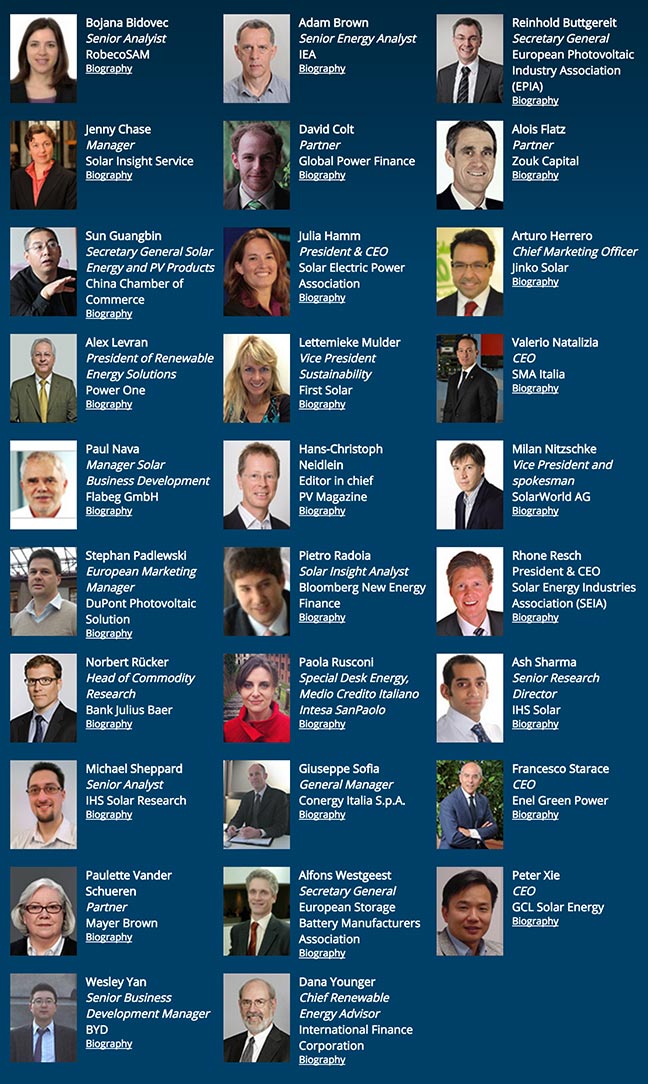
GUIDO AGOSTINELLI - Global Solar Alliance
PV markets: status and prospects, geographical segmentation and growth dynamics
JENNY CHASE - Solar Insight Manager, Bloomberg New Energy Finance
CREATING A LEVEL PLAYING FIELD (11:30-13:00)
Moderated by JENNY CHASE - Solar Insight Manager, Bloomberg New Energy Finance
Governing business cycles and resolving trade disputes: industry leaders, executives from the industry associations and institutional of representatives from Europe, Asia and North America engage in an open discussion on market competition and the conditions to create a level playing field.
RHONE RESCH - President and Ceo, U.S. SEIA - Solar Energy Industries Association
REINHOLD BUTTGEREIT - Secretary General, EPIA - European Photovoltaic Industry Association
MILAN NITZSCHKE - President, EU ProSun
PAULETTE VANDER SCHUEREN - Partner, Mayer Brown, AFASE Spokesperson
GUANGBIN SUN - Secretary General Solar Energy and PV Products, China Chamber of Commerce
PRESS BRIEFING (13:10-13:40)
RATIONALISATION (14:00-16:00)
The consolidation of the PV industry: strategies and transformation of PV companies across the value chain
Moderated by GUIDO AGOSTINELLI - Global Solar Alliance
The rationalisation of the solar industry
MIKE SHEPPARD - Senior Analyst, IHS Solar
Building strength: strategic positioning and strategic alliances
ALEX LEVRAN - President of Renewable Energy Solutions, Power-One
Building strength: pursuing leadership in mass manufacturing
ARTURO HERRERO - Chief Marketing Officer, Jinko Solar
Building strength: from products to services
GIUSEPPE SOFIA - Vice President, Conergy
EXECUTIVE ROUNDTABLE
Moderated by GUIDO AGOSTINELLI - Global Solar Alliance
A candid view on the PV industry and markets from the investors’ standpoint
ALOIS FLATZ - Partner, Zouk Capital
Short term planning, strategies and challenges to endure a tumultuous phase
ALEX LEVRAN - President of Renewable Energy Solutions, Power-One
ARTURO HERRERO - Chief Marketing Officer, Jinko Solar
PETER XIE - Ceo, GCL Energy
ALOIS FLATZ - Partner, Zouk Capital
NEW OPPORTUNITIES: EMERGING MARKETS (16:30-18:00)
The worldwide growth of the new PV markets and their increasing impact on the industry and its organization
Moderated by HANS-CHRISTOPH NEIDLEIN - Editor in Chief PV Magazine
- Emerging PV markets: growth drivers, business models, prospects
ASH SHARMA - Senior Research Director, IHS Solar
- The Chinese PV market: blowing like the wind
XU HONGHUA - Leader, China Research Program for High Penetration of Renewable Energy Development by 2050, China Academy of Sciences
- Catalyzing resources to promote renewable energies in emerging economies and developing countries
DANA YOUNGER - Chief Renewable Energy Specialist, IFC - International Finance Corporation (World Bank group)
- Emerging PV markets: local opportunities, impact on the global PV supply chain
CHRISTOPHER BURGHARDT - Vice President Business Development EMEA, First Solar
MAY 9
OPENING (09:50-10:00)
Welcome and introduction to day 2
GUIDO AGOSTINELLI - Global Solar Alliance
COMPETING IN AN OPEN ENVIRONMENT (10:00-11:15)
Playing a bigger game: the value of solar in the post incentive era
Moderated by JOSEFIN BERG - Senior Analyst, IHS Solar
- Concentrated solar power, status and prospects, value proposition
PAUL NAVA - Manager Solar Business Development, Flabeg
- Wind, biomass, geothermal & other renewable energy sources
ADAM BROWN - Senior Energy Analyst, IEA - International Energy Agency
- Shale gases and other non-conventional fuels: abundant fossil resources at low cost?
NORBERT RÜCKER - Head of Commodity Research, Bank Julius Bär
PANEL: Comparative value of solar power in the context of the global energy markets
RHONE RESCH - President and Ceo, U.S. SEIA - Solar Energy Industries Association
PAUL NAVA - Manager Solar Business Development, Flabeg
ADAM BROWN - Senior Energy Analyst, IEA - International Energy Agency
NORBERT RÜCKER - Head of Commodity Research, Bank Julius Baer
SUSTAINING AND FINANCING GROWTH (11:45-13:00)
The financing enviroment: markets, opportunities and instruments to sustain growth
The role of a functioning secondary market for assets
PIETRO RADOIA - Solar Insight Analyst, Bloomberg New Energy Finance
Business and financing models for self-consumption and arbitration
PAOLA RUSCONI - Energy Desk Specialist, Mediocredito Italiano - Intesa Sanpaolo
Financing operations: public equity markets and their reading of the sector
BOJANA BIDOVEC - Senior Analyst, Robeco SAM
Opportunity, drivers, barriers, short to mid-term scenarios in the development of solar assets
Panel discussion initiated by
DAVID COLT - Partner, Global Power Finance
SOLAR SCENARIOS: THE NEXT LEVEL (14:00-15:00)
Moderated by JULIA HAMM - President and Ceo, U.S. SEPA - Solar Electric Power Association
High grid penetration: a real barrier?
STEFAN NOWAK, Chairman IEA PVPS - Photovoltaic Power System Programme
Storage technologies, products and usage gaps
ALFONS WESTGEEST - Secretary General, EUROBAT - European Automotive and Industrial Battery Manufacturers Association
The impact of utilities on the solar market, the impact of solar on utilities
FRANCESCO STARACE - CEO, Enel Green Power
JULIA HAMM - President and Ceo, U.S. SEPA - Solar Electric Power Association
CLOSING DISCUSSION: AN INDUSTRY UNDER TRANSFORMATION (15:00-15:30)
Moderated by JULIA HAMM - President and Ceo, U.S. SEPA - Solar Electric Power Association
Reorganisation and profitability of the value chain, long term perspectives for the global PV industry
WESLEY YAN - Senior Business Development Manager, BYD
STEPHAN PADLEWSKI - European Marketing Manager, DuPont Photovoltaic Solutions
VALERIO NATALIZIA - Ceo and Managing Director, SMA Italia

More Background On Global-Solar-Summit.com
Global-Solar-Summit.com represents the digital home of an international conference positioned at the intersection of renewable-energy innovation, solar-power advocacy, and global economic transformation. Though the website originally focused on a specific 2013 event in Milan organized under the Global Solar Alliance (GSA), it continues to serve as a preserved snapshot of a moment when the global photovoltaic industry was undergoing unprecedented consolidation, turbulence, and growth. Today, the site offers a look into the ambitions, structure, goals, and intellectual environment of the Global Solar Summit—an event intended to unify market researchers, policymakers, investors, financiers, analysts, manufacturers, and thought leaders from every corner of the solar-energy world.
This comprehensive overview synthesizes the site’s available content, the historical context of the Summit, and additional research into the event’s goals, identity, and industry impact. It is intended to familiarize readers with the purpose, structure, audience, cultural relevance, and long-term significance of the Global Solar Summit, even as its original 2013 version survives primarily through archived material.
Ownership and Organizational Structure
The Global Solar Summit (GSS) was created as the official annual conference of the Global Solar Alliance (GSA). The GSA is described as a breakthrough initiative bringing together major exhibition organizers and solar-industry conveners across Europe, China, North America, and other regions engaged in large-scale renewable-energy events.
As documented, the Summit is not owned by an individual company, nor is it sponsored by a single manufacturer or national energy agency. Instead, the structure is collaborative:
-
Global Solar Alliance (GSA): Overseer and conceptual founder
-
Partner exhibitions in Europe: Often tied to large technology expos and renewable-energy trade fairs
-
Partner exhibitions in China: Reflecting the world's largest solar manufacturing ecosystem
-
Partner exhibitions in North America: Representing major markets, policy hubs, and solar-finance centers
Because the Alliance is composed of event organizers rather than product vendors or utilities, its stewardship tends to emphasize neutrality, information dissemination, and global cooperation.
The website does not name a corporate headquarters or a permanent base of operations, reflecting the Summit’s transnational identity.
Location and Event Setting
The 2013 edition—the version preserved on Global-Solar-Summit.com—took place in Milan, specifically at the Rho Exhibition & Conference Center, one of Europe’s largest venues for industrial and trade conventions.
Milan’s selection as the location reflected several strategic factors:
-
Italy’s rapid adoption of solar photovoltaic systems in the early 2010s
-
The city’s easy travel access for European, Asian, and American delegates
-
Its proximity to Solarexpo, one of Europe’s major renewable-energy exhibitions
-
A strong ecosystem of logistics, event infrastructure, and business travel
The Summit, however, is not permanently tied to Milan. The emphasis on global participation implies that future editions were expected to rotate across influential solar hubs.
Historical Context
By 2013, the global solar industry was at a pivotal crossroads. A few key historical dynamics shaped the Summit:
Market Consolidation
The industry was experiencing intense consolidation—manufacturers were going bankrupt, international trade tensions were rising, and global supply chains were being reorganized. China’s mass manufacturing dominance was reshaping pricing structures across continents.
Policy Shifts
European nations were adjusting feed-in tariffs. The United States was exploring new renewable-energy incentives. Asian markets were beginning to open aggressively. At this moment, alignment between policy and industry was more necessary than ever.
Emerging Markets
Solar development in Africa, the Middle East, South America, and Southeast Asia was rapidly accelerating. Investors were beginning to view solar as a mainstream asset category rather than a speculative or experimental one.
Turbulence and Opportunity
The 2013 Summit was positioned as a way to interpret these upheavals, offering market intelligence, panels led by industry executives, discussions of global policy, and sessions focused on business strategies to survive and thrive.
The preserved website captures this sense of urgency: the industry was “facing a tumultuous phase,” and the Summit was devised to help guide leaders through it.
Goals and Mission
The mission of the Global Solar Summit is multi-layered, with several clearly articulated objectives:
1. Strengthen Global Solar Collaboration
The Summit aims to connect stakeholders across continents, helping to reduce fragmentation in policy, supply chains, and regulatory environments.
2. Promote Solar as a Mainstream Solution
By focusing on business intelligence, investment strategies, and the long-term economics of solar energy, the Summit advocates for solar as a primary driver of the low-carbon transition.
3. Provide Market Intelligence and Thought Leadership
Panels and keynote sessions address:
-
Price trends
-
Manufacturing strategies
-
Global supply-chain risks
-
Energy-storage integration
-
Trade disputes
-
Investment vehicles and financing models
4. Support Emerging Solar Economies
Speakers and program tracks focus on developing markets, including rural electrification, grid expansion, and solar-plus-storage systems tailored for developing nations.
5. Serve as a Global Meeting Point
The Summit provides opportunities for networking among:
-
Investors
-
Executives
-
Manufacturers
-
Policymakers
-
Utility representatives
-
Analysts
-
Engineering and EPC (Engineering, Procurement, Construction) firms
By facilitating these interactions, the Summit encourages partnerships, strategic alliances, and cross-border collaboration.
Target Audiences
The Summit attracts a varied and unusually comprehensive network of participants. The website lists the following primary audience groups:
-
PV, CPV, and CSP solar-industry executives
-
Project developers and brokers
-
Owners of installation sites, industrial plants, and large-scale solar fields
-
Investment funds, equity investors, and financing institutions
-
Leasing and insurance companies
-
Law firms specializing in energy, trade, or project finance
-
EPC contractors
-
O&M (operations and maintenance) service providers
-
Energy-storage manufacturers
-
Transmission and distribution system operators
-
Analysts, consultants, and market researchers
-
Government policy decision-makers
-
NGO representatives and international development experts
The diversity of this audience underscores the Summit’s role as a comprehensive, full-ecosystem gathering place.
Program Structure and Session Themes
The 2013 program, fully preserved on the website, showcases the Summit’s depth and structure. It includes several major thematic tracks:
Opening Sessions
Featuring keynote industry researchers offering high-level insights into global solar markets, price dynamics, and technology adoption.
Market Competition and Trade
Panels addressing:
-
Trade disputes between major economies
-
Market distortions caused by subsidies
-
Policy harmonization
-
Strategies to create a global “level playing field”
Industry Rationalization
Sessions exploring:
-
Consolidation among manufacturers
-
Strategies for scaling production
-
Transition from hardware-driven offerings to service-oriented models
Executive Roundtables
Closed-door style discussions among C-suite leaders focusing on:
-
Investor perspectives
-
Long-term market strategies
-
Scenario planning
Emerging Markets
Panels analyzing growth drivers in Asia, Africa, Latin America, and the Middle East, including:
-
Electrification challenges
-
Off-grid and mini-grid applications
-
Policy roadmaps
-
Local manufacturing potential
Comparative Energy Economics
Sessions comparing solar power to:
-
Wind
-
Biomass
-
Geothermal
-
Shale gas
-
Conventional fuels
This reflects the Summit’s commitment not just to solar advocacy but to energy-system analysis as a whole.
Financing and Investment Tracks
Including:
-
Equity markets
-
Debt financing instruments
-
Self-consumption business models
-
Secondary markets for energy assets
Future Scenarios Sessions
Exploring topics such as:
-
High grid-penetration challenges
-
Battery-storage technologies
-
The relationship between utilities and solar developers
-
Next-generation market strategies
Closing Discussions
Summarizing insights on supply-chain profitability, long-term industry transformation, and global solar leadership.
Reviews, Reputation, and Industry Reception
Although Global-Solar-Summit.com itself does not host reviews, the event’s structure reflects a high-level audience. Industry professionals recognized the Summit for:
-
Its intellectual seriousness — bringing data-driven researchers from Bloomberg New Energy Finance, IHS Solar, and European and American solar associations.
-
Its global focus — combining speakers from China, Europe, North America, Africa, and developing markets.
-
Its multi-disciplinary approach — uniting economics, policy, finance, and technology in equal measure.
While not necessarily a mainstream consumer-facing event, the Summit earned credibility in the solar-energy professional community. Participants viewed it as a practical, high-level intelligence forum rather than a trade-show-style expo.
Cultural and Social Significance
The Global Solar Summit reflects several broader cultural movements of the early 2010s:
1. Transition Toward Renewable Energy
The website captures a pivotal moment in the global shift from fossil fuels to renewable alternatives. It documents debates about grid penetration, utility adaptation, and long-term transitions.
2. International Cooperation
The Summit embodies solar energy’s inherently global nature—where manufacturing, finance, policy, and deployment cross borders. It showcases an international willingness to collaborate on climate issues.
3. Democratization of Energy
By presenting solar as a solution applicable to all sectors—from small businesses to large utilities—the Summit reflects a global desire for energy independence, resilience, and affordability.
4. Industry Professionalization
The detailed programming illustrates how solar had evolved from a niche environmental interest into a sophisticated economic sector with:
-
Analysts
-
Investment specialists
-
Legal experts
-
Advanced manufacturing
-
Global supply chains
Press and Media Coverage
While the Summit was referenced in industry-specific circles, most coverage exists in archived press releases, exhibitor announcements, and renewable-energy newsletters from the early 2010s. The preserved website does not link to an explicit press room. Instead, its visibility came from:
-
Energy trade publications
-
Renewable-energy associations
-
Professional networks and partner exhibitions
-
Industry analysts such as Bloomberg New Energy Finance
This makes Global-Solar-Summit.com more of a specialized industry resource rather than a mainstream media subject.
Technical Details and Site Characteristics
The website itself is simple, informative, and structured for professional audiences. Key features include:
-
A concise homepage explaining the Summit’s goals
-
A full program schedule broken down by date and session
-
Descriptions of target groups
-
Information on registration, language, and logistics
-
Organization credits identifying the GSA
One of the most striking elements is how much detail is provided about panelists, their affiliations, and the specific topics addressed—underscoring the Summit’s role as a serious industry forum.
Legacy and Long-Term Impact
Even though the 2013 edition is the one preserved today, the Global Solar Summit contributed to several lasting developments:
-
Greater recognition of solar as an investable global asset class
-
Increased cooperation between Europe, Asia, and North America in renewable-energy policy
-
Early discussions about utility transformation and energy-storage adoption
-
Frameworks for analyzing emerging solar markets
-
Stronger partnerships within the global supply chain
While the site does not catalog later editions, the preserved 2013 Summit remains a meaningful snapshot of a formative period in solar history